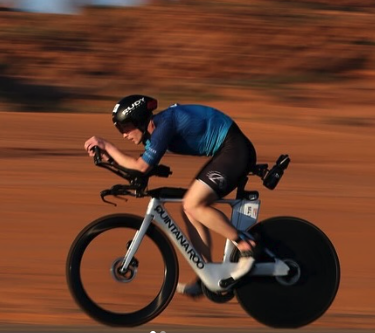
A question that comes up frequently when I speak with athletes is what crank length they should use. Over the past several years, there has been a noticeable shift toward shorter crank lengths in triathlon, particularly among athletes racing in more aggressive aero positions.
What Is Crank Length?
Crank length refers to the distance from the center of the bottom bracket to the pedal spindle. Historically, 175 mm cranks were considered standard for most cyclists. More recently, that convention has shifted. It is now common to see athletes on 160-170 mm cranks, and in some cases even shorter. Among the athletes I work with, 165 mm has increasingly become a common starting point, though not a hard rule.
Why Have Shorter Cranks Grown in Popularity?
The primary reason shorter cranks have gained traction is positional. Shorter crank arms reduce the diameter of the pedal circle, which in turn reduces hip closure at the top of the pedal stroke. In aggressive triathlon aero positions, this increase in effective hip angle can improve comfort, breathing, and the ability to sustain power while remaining aerodynamic. In many cases, it allows athletes to hold an efficient aero position longer, which matters far more than peak power measured in a lab.
What shorter cranks do not do
Shorter cranks are not a shortcut to higher power or free speed. They do not automatically raise cadence, improve efficiency, or fix poor bike fit. Their primary benefit is positional: enabling athletes to maintain an effective aero posture with less musculoskeletal strain over long durations.
What About Power and Efficiency?
A foundational 2019 study study demonstrated that power output remains largely unchanged across a wide middle range of crank lengths, forming a clear plateau in the power–crank-length relationship. Meaningful reductions in maximal power were only observed at the extremes, with very short cranks (below roughly ~140–145 mm) and very long cranks (above ~190–200 mm). Even across the full range tested (approximately 120–220 mm), total variation in maximal power was only about 4%.
The practical implication is that even the shortest commercially available crank lengths (roughly 150–165 mm) fall well within the range where power production is effectively preserved. For triathletes, this means choosing a shorter crank to improve position or comfort is unlikely to come with a meaningful power penalty, particularly at steady-state race intensities.
More recent studies reinforce this conclusion. A 2021 study examining very short cranks (145 mm vs traditional 175 mm) showed improved cycling economy (i.e., more power at the same oxygen cost) with shorter cranks in novice riders at moderate intensity (60% of VO2 max), possibly due to the “slower pedal speeds, slower muscle contraction velocities and more extended hip and knee joints that a short crank length affords.”
A 2025 study further showed that within the typical range of adult crank lengths, shorter cranks do not meaningfully reduce cycling efficiency or power output, and can even lower perceived effort without compromising performance. A controlled study comparing 165 mm, 170 mm, and 175 mm cranks found no significant differences in measured efficiency or power, but riders on shorter cranks reported lower perceived exertion at the same submaximal workloads. This suggests that triathletes might consider running shorter cranks to enhance comfort, positional sustainability, and long-course resilience.
When to consider shorter cranks
Given the above, shorter crank lengths are often worth considering if you:
Ride in a low or aggressive aero position
Feel restricted or “jammed up” at the top of the pedal stroke
Struggle to stay aero late in long rides
Experience hip or low-back discomfort on the bike
Want to improve durability heading into the run
Why This Matters for Triathletes
For triathletes, especially those racing 70.3 and Ironman distances, these findings are highly relevant. Shorter crank lengths do not appear to compromise efficiency or power, but they can meaningfully improve comfort, positional sustainability, and perceived effort while riding in aero—factors that directly influence durability and run performance. As a result, crank length decisions should be framed less around theoretical power production and more around an athlete’s ability to sustain position, manage fatigue, and execute the entire bike-to-run sequence effectively.
Among the athletes I work with, 165 mm has increasingly become a common starting point. Ultimately, however, the best crank length in triathlon is the one that allows you to stay aero comfortably, produce steady power late, and arrive at T2 ready to run.
Conrad Goeringer is an Ironman Certified Coach based out of Nashville, TN. He is the founder of Working Triathlete and author of the book The Working Triathlete. His passion is helping athletes of all levels and with all schedules achieve their endurance goals. Reach out to learn more about coaching packages and for a free consultation.